Contrary to what was hoped for, global CO2 emissions actually increased in 2018.
 Every major city in Europe is warmer in the 21st century than it was in the 20th. In December 2015, 195 member states of the UN agreed in the Paris Agreement to limit the temperature increase to 1.5⁰C above preindustrial levels. For several cities on the Iberian Peninsula, this 1.5⁰C threshold has already been reached.
In Lisbon – situated on the Atlantic Coast – the average temperature increased 0.5⁰C and the number of hot days (24-hour average temperature above 24⁰C) nearly doubled since 2000.
 Even limited temperature increases have severe consequences. A hotter atmosphere can absorb more water leading to severe floods between longer and dryer periods. Heatwaves lead to excess mortality and mosquito-borne diseases like dengue fever has been creeping North with epidemics in Portugal in 2012. Recent research shows that when the daily temperature increases above 22⁰C, cognitive abilities of schoolchildren decrease.
The expectations are that the Mediterranean will heat up more than the global mean, resulting in a substantial decrease in the production of hydroelectric energy of which Portugal is more dependent than the Northern European countries.
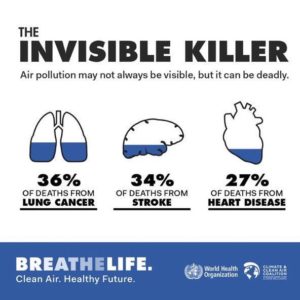 Although Portugal had in 2018 the highest reduction in CO2 emissions of all EU member states, CO2 emissions of its national airline TAP skyrocketed in the last 2 years. This was mainly the result of an explosive 30% increase in the number of passengers.
Booming tourism has become the main money-spinner generating annually more than € 14 billion in government revenues but the downside is pollution.
Portela airport – with more than 650 flight movements per day – knows few restrictions for night flights with planes coming in just a hundred meters above rooftops.
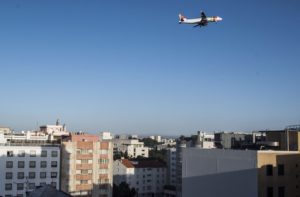 Ultrathin particles are 20 times higher close to the airport than elsewhere in the city. Measurements of inner-city noise levels taken by the environmental group ZERO showed noise pollution for more than 400.000 people with levels above the legal limits of more than 16 dB at night and 10 dB during daytime.
About 300 giant cruise ships – with at least 600.000 passengers to embark – are every year docking at a brand-new (€ 50 million) terminal. Even though only 2 years old there is no portside electricity for the moored vessels.
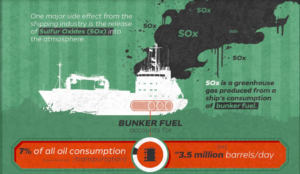 Massive amounts of particulate matter and sulphur dioxide (SO2) have made Lisbon’s port the sixth most polluting in Europe.
SO2 emissions from those ships are 85% higher than those emitted by Portugal’s entire car traffic over a year.
Climate change can only be achieved by keeping hydrocarbons in the ground and capturing carbon from the atmosphere. Neither option has produced any result so far.
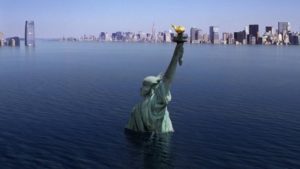 In order to prevent global warming catastrophe policymakers have to get serious about a carbon tax set high enough to price oil, coal and gas out of the market says William Nordhaus, one of the winners of last year’s Nobel Prize for economics.
Bom fim de semana Enjoy your weekend (pic Público/Observador)
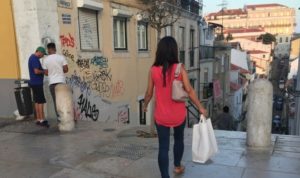 In 2001 Portugal became – under the leadership of prime minister António Guterres, nowadays UN’s Secretary-General – the first country to ‘
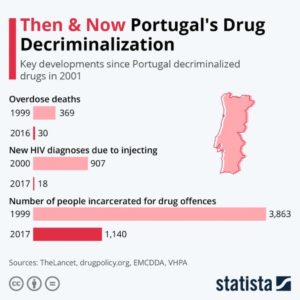 Despite predictions at the time of an increase in drug use and drug tourism by opponents of decriminalization, the opposite happened with huge drops in drug use, overdose deaths, drug-related crime, and HIV infection. New cases of
 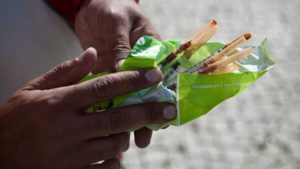 The country’s
 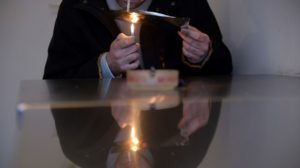 What did and what did the country not do?
 There are currently two Threshold Mobile Units in Lisbon – attending approximately 1,200 people a day – and 170 recovery facilities in a country of 10 million people for treatment and education about the harmful effects of drugs.
 While other states have developed various forms of de facto decriminalization – whereby substances perceived to be less harmful (such as cannabis) rarely lead to criminal prosecution – Portugal remains the only EU member state with a law explicitly declaring drugs to be ‘decriminalized.’
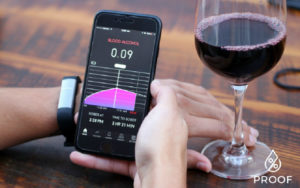 What does this mean for the health of the Portuguese? Excessive alcohol intake is associated with road traffic accidents, cancer, diabetes, heart disease, domestic violence, and suicide attempts.

 Given the fact that there is no
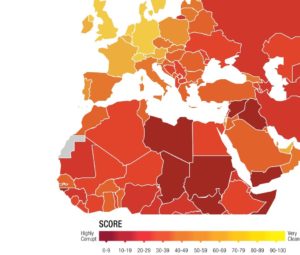 Perceived corruption in Portugal has for many years been just below the
  The low number of convictions and the fact that
  Corruption costs the country at least
 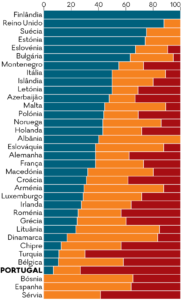 It is therefore not surprising that Portugal is the least compliant of 49 European countries in the fight against corruption. A report from the Council of Europe’s anti-corruption group (
 The Spanish company DIA, owner of the supermarket chain Minipreço recently announced the removal of any ceramic frogs at the entrance of its 530 stores in Portugal. The reason for his was the complaint of a customer, who sent photos to the newspapers of a frog at the entrance of a Minipreço branch in Várzeas, in the Leiria district.
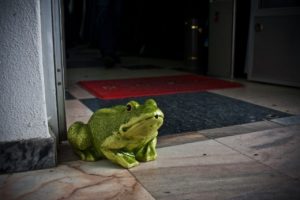 The racist practice of Portuguese shopkeepers to use bright green ceramic
 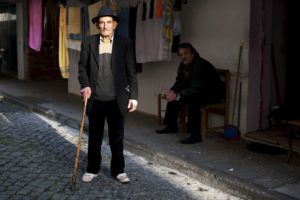 ‘Most Roma live below the poverty line and are not properly informed about their rights. There is a lot of resignation: many Roma don’t complain because they don’t think complaining will change anything’, says Marta Pereira, activist and SOS racism member (
 According to a report published last year by the European Commission against Racism and Intolerance,
 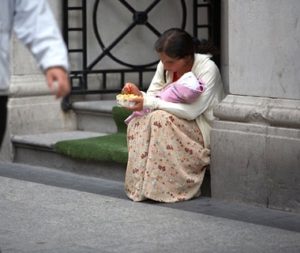 Although the country adopted in 2013 a National Strategy for the
 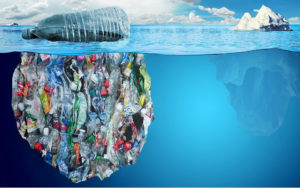 Plastic has proven to be indispensable in our global economy; most is used as packing material. Despite the fact that over 13 million tons of
  In Europe circa 30% of plastic is recycled.
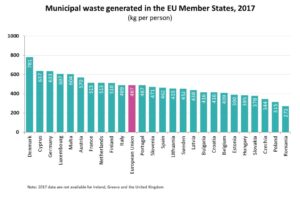 Every Portuguese citizen produces about 480 kg of garbage per year (~
 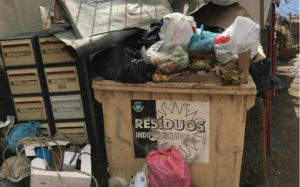 Since the
  Each year the Portuguese throw away
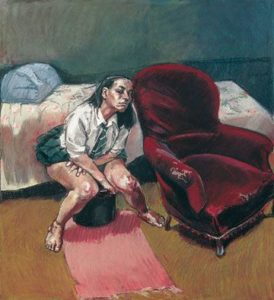 Back in 1998, the now 84-year-old artist created a series of paintings –
 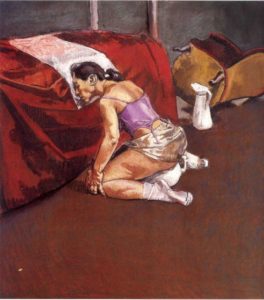 It lasted until 2007 before this mistake was corrected and abortion laws in Portugal were liberalized.
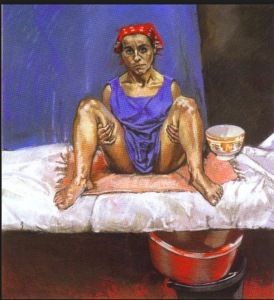 The exhibition Paula Rego: Obedience and Defiance’ will be the first major retrospective of her work since the 1960s. To support the exhibition – that opens on 15 June at MK Gallery in Milton Keynes, UK – the artist has offered a limited edition print from her celebrated series hoping the etching Untitled Abortion, 2000 will help draw attention to the dangers of making abortion illegal again.
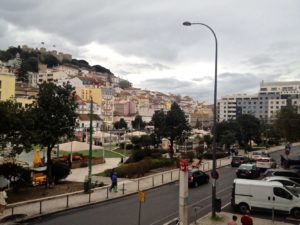 The history of Lisbon and Mouraria – one of the city’s oldest quarters – both originate from the presence of diverse people and cultures. In 1143, Lisbon was conquered from the Moors by King Alfonso Henriques, becoming a Christian city. The birth of Mouraria goes back to the same period, built outside the walls as the only territory where Moors were authorized to reside.
 In the 16th century, the first black migrants were forced into slavery in Lisbon, in that era the largest European centre of the flourishing slave trade. The number of slaves present in the capital reached 10% of the total population, that time comprising 100,000 inhabitants.
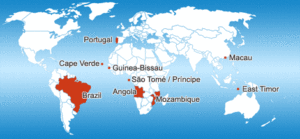 On 25 April 1974, Portugal became a democracy after 48 years of dictatorship. Between April and November 1975, Portugal took in half a million Portuguese and their descendants from its
  Mouraria is the most multicultural neighbourhood of the capital. Here you find everything from African grocers to Chines tea, Indian clothing, religious talismans, Bengali restaurants, mosques and halal butchers. The percentage of foreign residents (25%) is well above the average for the city (10%) and the nation (less 4%).
 In the heart of Mouraria resides the
  Twenty EU states have golden visa or similar programs.
 In the past six years – between October 2012 and January 2019 – over 7000 golden visas have been issued by the Portuguese authorities. In particular to Chinese (> 4000), followed by Brazilians, South Africans, Turks and Russians. It yielded the treasury the sweet amount of 4.3
  Just like luxury goods, residence rights are for sale. A multibillion-euro industry but not without risks. Real estate has always and everywhere been attractive to money laundering, corruption and tax evasion.
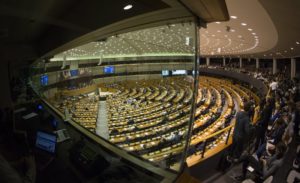 A special commission of the European Parliament suggested
  The majority in the Portuguese Parliament even wants to go a step further in the residency scheme for wealthy foreigners by introducing ‘
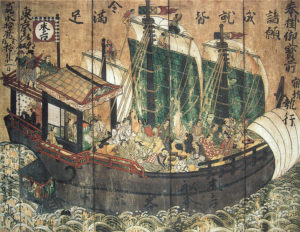 In 1543 a Chinese ship with three Portuguese sailors on board – António da Mota, Francisco Zeimoto and António Peixoto – heading for Macau was swept off course and ended up on the Japanese island of Tanegashima. The Japanese were in the middle of civil war and eventually began trading guns with the Portuguese. This way the first trading post in Japan became a fact.
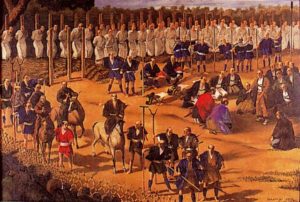 The Portuguese remained in Japan for nearly a century – until
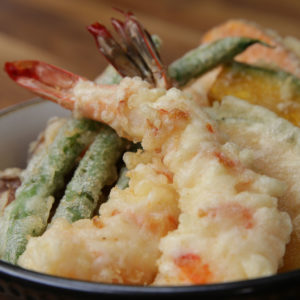
  Peixinhos da horta was often eaten during Lent – the 40-day period before Easter that in Christianity is devoted to fasting and abstinence – when the church dictated that Catholics were not allowed to eat meat.