Tag Archive for: traditional

Europe’s oldest ceramics factory

The Sant’Anna factory – established in 1741 – is Europe’s oldest ceramics factory, renowned for producing traditional Portuguese hand-painted tiles (azulejos) and ceramics, using entirely handcrafted methods.

Sant’Anna was born in the neighbourhood of Lapa and initially produced bricks. In 1755, after the apocalyptic earthquake (terramoto) – that completely whipped out the lowest part of the capital – the factory began to produce tiles to cover the facades of the buildings and help in the rehabilitation of the capital.

It’s been 125 years since the factory moved to Calçada de Boa Hora in the Ajuda district, a clayey area where the raw material was easily extracted and where the artisanal production of tiles and ceramics could be continued.

‘Our collections, nowadays, are mainly reproductions of the 18th century’, says Mariana Felício, graphic designer in the newspaper Público, ‘but of course we do everything the client wants because when we talk about manual work, we can make things a machine cannot.’

For the production of the traditional Portuguese tiles -without relief – a roller, a mold, and a knife are used. ‘The process is similar to that of making Christmas cookies’, says Mariana. ‘With the roller, the clay is pressed on the table, placed in an eight-millimetre gauge, which is the thickness of the traditional tile, and cut one by one with our square mold and knife.

After four to six weeks of drying, the tiles are ready to go the oven for a first two-day cooking at 1100 °C.  After cooling down the next stap is made by a single person, who focuses on listening to the tiles one by one to find out if the tile is good or not to be glazed and painted, explains Mariana.

‘To do this, you hit the tile with a small piece of wood. If a metallic noise sounds, the tile is in good condition. On the other hand, if the tile has a more hollow sound, it means there are air bubbles inside that can lead to breaking in the next cooking step.’

‘Sometimes, the artist works seven, eight hours just on one tile. What happens is that we will waste eight hours of the artist’s work if the tile is not good. That’s why it is important to do this type of – most traditional and original possible – test before proceeding to glazing, painting and firing up the oven again.’

Today, 85% of the production is exported abroad, mainly to the US. In addition to private customers – who make up the majority – the factory also works with architects and interior designers on projects such as hotels ( the Ritz, for example) and requalification of buildings.  

Visitors can observe artisans crafting tiles using traditional techniques and purchase pieces ranging from classic 18th century designs to contemporary styles. The factory (www.santanna.com.pt) also offers tile painting classes.

Enjoy your week                             Approveite a semana
Traditional food is based on fish, seafood or pork with lots of olive oil.

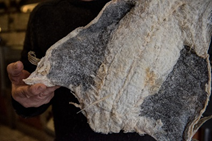
Bacalhau is the undisputed National dish, especially on Christmas Eve when 4 to 5 thousand tons of Norwegian cod is devoured.
Cod became prominent during the Discovery Era because it could be stored for longer periods. You can see and smell the large hard chunks in shops, where a small saw is often used to cut the fish. Salted cod is primarily soaked for at least 24 hours in water before cooking, grilling, frying, or braising

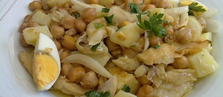
Popular dishes are cod baked with cream (bacalhau com natas), stir-fried with shredded potato, eggs, and onions (bacalhau à brás) and cod with chicken peas (meia-desfeita).
Meia-desfeita (‘half-undone’) stems from the times when one used to order only half the dish.

Arroz de marisco consists of rice, monkfish, and seafood like prawns, mussels, squid, or clams and is usually seasoned with fresh herbs and white wine. Unlike the Spanish paella, it is not fried and often described as a thick rice stew.

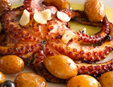
Polvo à Lagareiro is made in the style of Lagareiro. In this case, the octopus is boiled, then cut into pieces, grilled, and brushed with extra virgin olive oil. The dish is dressed with a combination of garlic, coriander, lemon juice, and salt, served with small roasted potatoes with their skin intact and lots of olive oil.

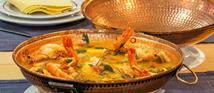
Cataplana de marisco refers to a popular fish- or seafood dish sharing the same name as the clam-shaped copper pan in which it is prepared. The Moors introduced the dish which usually includes white fish, shellfish, red peppers, onions, and a bit of chili.


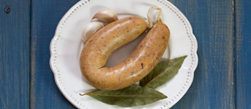
Alheira is a smoked sausage typically made with various types of meat, bread, garlic, olive oil, and paprika. It is believed to be invented during the Inquisition by Portuguese Jews. To disguise as Christians they started producing pork-like sausages but would replace the traditional pork with poultry and game.


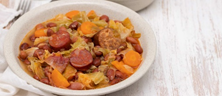
Feijoada à portuguesa is a hearty bean stew originating in the north of the country before it was introduced in Brazil, where it is considered the National dish. It is made with red kidney or white beans and usually includes pork (ears, foot), morcela (blood sausage), or chouriço.

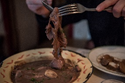
Iscas com elas are thin strips of cow’s liver, sautéed in wine and garlic. They’re served with boiled potatoes (referred to as elas – meaning them). The dish was brought to the country by the Galicians, who arrived in the 18th century to work in, and later own restaurants and cafés.


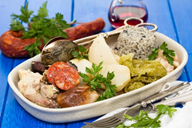
Cozido à portuguesa is a rustic stew for meat lovers. It usually consists of beef, pork, chicken, and smoked sausages, such as morcela, chouriço, or alheira. It might also contain other bits of animal-like pig’s ear or foot – and potatoes, cabbage, or carrots. All the ingredients are cooked together in a single pot with different items added at different times.


Boas Festas        Stay Healthy      (pic tasteatlas/roads&kingdoms/sapo)