Carving portraits out of walls

Vhils – Alexandre Manuel Dias Farto – is a Portuguese street artist born in 1987 near Lisbon.
He studied at the Byam Shaw School of Art in London and nowadays lives and works between London and Lisbon. He is best known for his unique technique in urban art: carving portraits out of the city.

He began as a teenager with conventional graffiti and around 2011 developed the low-relief carving method that made his name. Using chisels, drills and jigsaws, he strips layers of plaster and paint on aging walls to reveal striking human portraits hidden beneath the surface.

The result looks almost archaeological, as if the face had always been there, waiting to be discovered rather than added. His subjects are typically ordinary and anonymous people rather than celebrities, reflecting his fascination with the neglected lives embedded in a city.

He gained international attention when his work of a face carved into a wall appeared alongside a piece by Banksy at the Cans Festival in London in 2008. Since then he has taken his art global, working across Europe, Asia and the Americas. He treats destruction as a creative process rather than an act of vandalism.

Vhils’ art engages with themes of urbanisation and globalisation, often responding to the specific history of a place. In Brussels, he created a mural blending imaginary from several European democratic revolutions, including Portugal’s Carnation Revolution, as a response to the far right. He has also expanded beyond walls into new materials – in a 2022 solo exhibition in Seville, he presented tile-based pieces for the first time, and more recently produced large sculptural works.

His achievements have been widely recognized in Portugal and abroad. A major retrospective – ‘Strata’ – at Munich’s Museum of Urban and Contemporary Art (Strata) traced his artistic evolution from 2005 to 2025 across a range of materials and techniques. In 2023, the Boutique Hotel ‘Artsy Cascais’ was inaugurated with a facade designed by the artist.

This year, Lisbon’s MUDE Design museum marked 20 years of his career with an exhibition of his most famous editions. His work also appeared in institutional spaces once considered untouchable by street art, including a mural for UNESCO headquarters in Paris.

Today, Vhils stands as one of the most distinctive figures in urban art, an artist who doesn’t add to the city’s surface – like his contemporary Bordalo II – but excavates it.

By the way, do you know that Lusolobo is turning 10 this month?
The first blog – in Dutch – was published on October 28, 2016 and called ‘
huurders’ (tenants).
An issue that is even more relevant today as it was ten years ago.

Enjoy your week                                  Aproveite a semana                                 (pic wikimedcom)
GLAZIG

‘Denk je dat ie het gedaan heeft?’

‘ Wie’? bromt Douwe, die zijn zakken afklopt op zoek naar sleutels.

‘Als je hier wacht, loop ik gauw terug naar binnen. Misschien dat ik ze in de squashzaal heb laten liggen.’

Op de uitgestorven parkeerplaats van Holiday Inn danst warme lucht boven gloeiend asfalt. De geblutste Renault 4 staat mistroostig naast een uitbundig bloeiende frangipani, die weliswaar een bedwelmende geur verspreidt maar amper schaduw geeft.

‘Hebbes.’

Ik draai me om en zie Douwe fanatiek met een bos sleutels zwaaiend naar me toe lopen.

‘Wat zei je daarnet over iemand die iets gedaan zou hebben?’

‘Heb je de Chronicle vanmorgen dan niet gelezen,’ vraag ik verbaasd.

De stadskrant van Bulawayo blinkt niet alleen uit in onmogelijk te verifiëren nieuwsfeitjes maar is bovendien dunner dan een bijsluiter.

‘Over onze superintendent van UBH, die zich in zijn ‘private rooms’ aan haar ‘private parts’ vergrepen zou hebben. Natuurlijk ontkent hij alles maar zijn patiënt blijkt het liefje van een hotshot in de partij te zijn.’

‘Een chirurg moet zich bij zijn vak houden en zich niet op andermans terrein begeven, zeker niet op dat van een gynaecoloog’, zegt Douwe met een grijns terwijl hij de sleutel omdraait, de snikhete auto in de eerste versnelling zet en het gaspedaal indrukt. De Renault schiet vooruit maar komt direct daarna met een enorme klap tot stilstand. Aangezien ik nog niet in de autogordels zit, word ik met brute kracht tegen de voorruit geslingerd, waarna ik even de weg kwijt ben.

‘Wat was dat in godsnaam,’ stamel ik, terwijl ik het bloed uit mijn ogen wrijf en zie dat de voorruit gebarsten is.

‘Geen idee’, roept Douwe, die de auto uit springt en naar de voorkant van de Renault rent.

‘Jesusmina, welke gek zet er nou van die lage paaltjes midden op een parkeerterrein? zegt hij met een diepe zucht, terwijl hij achter het stuur kruipt.

‘Het spijt me echt heel erg. Door de lage zon heb ik die stomme paaltjes helemaal over het hoofd gezien. Maar, gaat het wel goed met je? Weet je waar we zijn en wat voor dag het is?’

‘In ieder geval een dag om niet gauw te vergeten’, antwoord ik benepen.

‘Jeetje’, gilt Sandra als we bij hem thuis aankomen. ‘Je zit vol bloed. Ga hier zitten, ik haal een washand en een pincet want ik denk dat er nog glassplinters in je voorhoofd zitten.’

‘Hoe is het nu,’ vraagt Douwe bezorgd als Sandra naar de badkamer is gesneld. ‘Wil je paracetamol of whisky,’

‘Doe maar allebei’, mompel ik gelaten. ‘Het bloeden valt wel mee maar ik barst van de koppijn.’

Als alle splinters zorgvuldig verwijderd zijn, de paracetamol is ingewerkt en de whisky fles halfleeg, komt mijn tong los.

‘Ik had nooit gedacht dat ik met mijn hoofd een voorruit van een auto zou kunnen kraken’, brabbel ik onvast. ‘Al is het dan bij een aftandse Renault.’

Douwe kijkt me geamuseerd aan, opgelucht dat het voorval geen blijvende schade heeft opgeleverd.

‘Nou dat hangt natuurlijk wel van de dikte van het glas af’, zegt hij terwijl hij naar de lage, glazen salontafel wijst waar we met zijn allen omheen zitten. ‘Daar kun je op staan!’

Overmoedig geworden door whisky, vat ik zijn mededeling letterlijk op en stap pardoes de tafel op, die met donderend geraas in stukken uiteen valt.

                                                                                                                                     17-X-2026;  Douwe 80 jaar

Portuguese consume twice the recommended calories !

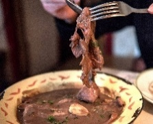
Some foods in Portugal still feature a ‘snout-to-tail’ culinary tradition, a practise of cooking that utilizes every edible part of the animal. Organ meats like liver, heart, kidney, tongue, tripe (stomach) are often hidden in sausages or served in specific regional varieties.

Iscas com Elas is iconic to Lisbon, where it was brought by the Galicians, who arrived in the 18th century to work in the capital. A traditional dish consisting of thinly sliced liver marinated in garlic and wine and cooked with onions. They are served with boiled potatoes (referred to as ‘elas’, meaning ‘them’).

Arroz de Cabidela – rabbit or chicken rice cooked with the animals blood and vinegar -is a traditional speciality from the northern Minho region of the country and documented since the 16th century. 

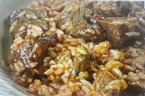
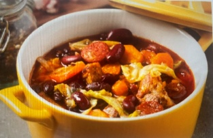
Tripas à Moda do Porto is a thick stew of white beans, sausages and pork stomach, famously associated with the city of Porto but widely known across the country, where it is called Dobrada.

Sarrabulho, a traditional northern Portuguese stew or thick soup – when thickened with flour called Papas de Sarrabulho – made from pork offal (liver, heart and kidney), and seasoned with cumin and animal blood.

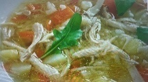
Chicken feet is a traditional ingredient in the Portuguese cuisine, used to make rich broth for soups,  such as canja de galinha (chicken soup) or stewed with garlic, onion and spices.

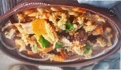
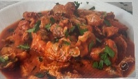
Moelas is a spicy dish made with tender chicken stomachs, slow cooked in a rich sauce made of tomato, onion, garlic, white wine and piri-piri peppers.

—>The perfect accompaniment to Portuguese meals are cheese and bread.

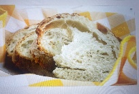
According to the Taste Atlas the Alentejo bread is part of the Top 10 best breads in the world. Its ‘rustic and thick crust that contrasts with the soft and airy crumb inside’ earned it 7th place on that gastronomic platform last year.

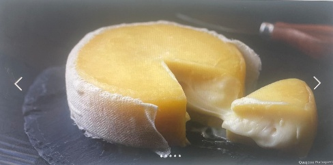
The top cheese from Portugal – Queijo da Estrela – was two years ago called the best sheep cheese in the world. A semi-soft cheese made from the milk of Bordaleira Serra da Estrela and Churra Mondegueira breed of sheep. Milking is done by hand, after which the milk is heated, salted and curled using thistle extract.

The cheese has a creamy interior, yellowish-white in color, while its flavor is sweet and slightly sour. It is the country’s oldest traditional food product with international acclaim. In the 13th century, the king of Portugal opened the first cheese market in Celorico da Beira, in the Serra da Estrela mountain range, where the cheese is still produced today.

 The Portuguese are among those, who spend the most on food in the EU. Eurostat data – reported by the weekly newspaper Expresso – show that the country ranks 1st among  the 27 member states, if the costs of living were the same all over Europe. 

 One wonders if all that eating has any relation with the fact that 6 in every 10 Portuguese are missing teeth?

Enjoy the week                     Aproveite a semana      (pic Tasteatlas)