Portuguese artistic pavement under threat
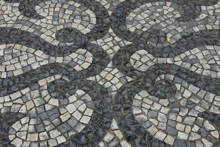
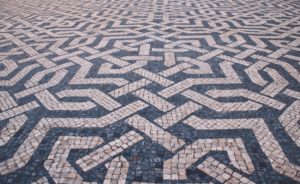
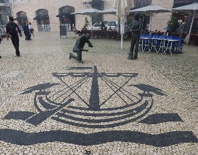
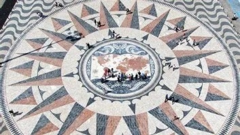
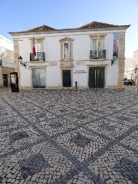
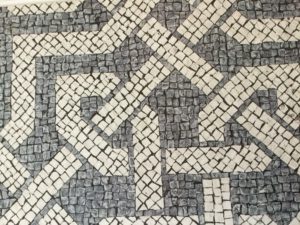
In almost every village, town and city in Portugal you will find parts of the unique traditional Calçada Portuguesa pavement made up of black and white decorative cobblestones.
This masonry art craft is unique to Portugal – mainland, islands and former colonies – and an iconic part of its cultural craftmanship.
It has its first origins from the Romans who used stoned and mosaics to make roads. Later, the Moors – during their time on the Iberian Peninsula between the 8th and 12th century – added to the craft by making geometric patterns on their floors.
However, it was in the 19th century that the art developed further as the first large calçada area was created in 1842 at St. George Castle in Lisbon.
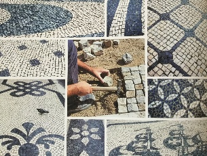
Over time, the Calçada Portuguesa has consolidated itself as a fundamental element of the urban landscape, contributing to the Portuguese history and culture whereas the Portuguese Calçada Association is bidding for UNESCO Intangible Cultural Heritage status for the art and knowledge of how to lay Portuguese cobblestones.

In the meantime, the Lisbon Paver’s school – which is celebrating its 40th anniversary this year – is ‘virtually defunct,’ argues Nuno Almeida, President of the Municipal Workers Union (STML).
The trade union leader points out that in the past the school fostered a great deal of knowledge and helped recruit workers – called mestres calceteiros (paving masters) – but ‘over the last 15 years there has been a dramatic reduction in the provision of comprehensive training courses, which is also why the school has failed to attract the attention of young people.’
He further emphasises, that there is a trend towards outsourcing these services with private contractors being hired instead of recruiting staff onto Lisbon’s City Council permanent staff. ‘We strongly urge the Council to reinstate the school not only as a training initiative, but also as a means to attract workers. At present, apprentices are thrown straight into practical work without any prior training and have to learn from their colleagues.’
With only 20 paving masters nowadays, most already of advanced age, ‘the profession of paver is at risk of disappearing from the city, not solely due to the threatening closure of the school but also because of the lack of recognition and appreciation of the workers within the public sector and the issue of low wages’, he explains.
Joana Baptista – the councillor responsible for Public Spaces at Lisbon City Council – takes a different view, declaring that the Council has been strengthening its training programme and is recruiting new staff. ‘There is even an ongoing recruitment initiative for 20 vacancies to double the number of professionals specialising in Portuguese paving, which is expected to be completed by the end of the year’, she declared.
Enjoy the week Aproveite a semana (pic Lusa/Sapo)
 Since Portugal has been declared World’s Leading Destination and Lisbon Best City Break in 2017, I’ am sure you are dying to visit the country in order to see for yourself, whether these prestigious awards are justified.
 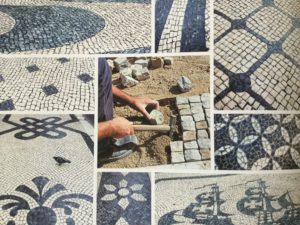 However, that hasn’t always been the case. It started as a forced task performed by prisoners in the nineteenth century. Only later it evolved into a craft and pavers (calceteiros) became recognized artisans, whose art became appreciated in such a way, that it spread to many cities and continents.
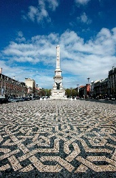
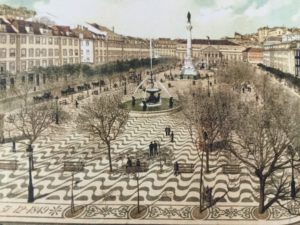 It became an immediate success and similar works were ordered, such as the paving of Lisbon’s major square Praça D. Pedro IV – popularly known as Rossio (meaning ‘wide and public space’) – that took place between 1846 and 1849.
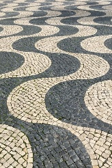
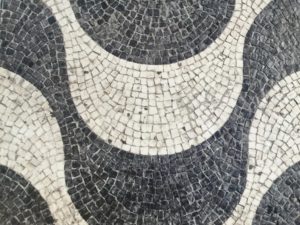 The pavement of Rossio was called ‘Wide Sea’ (Mar Largo) for depicting waves, symbolizing the encounter between the Tagus river and the Atlantic Ocean, which launched the Portuguese into the Discoveries in the 15th century. After Rossio, Lisbon adopted mosaic pavement for all its squares and sidewalks and it became the most popular pavement in historic Portuguese towns and famous worldwide.