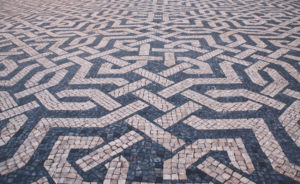
Portuguese ceramic tiles encapsulate centuries of history and artistic evolution
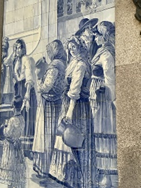
Azulejo – derived from the Arab word Az-zulayi (‘polished stone’) – is a form of Portuguese and Spanish painted tin-glazed ceramic work found on the interior and exterior of churches, palaces, houses, restaurants, and even railway or subway stations. Although an ornamental art form, these tiles also serve a functional purpose by preventing humidity.
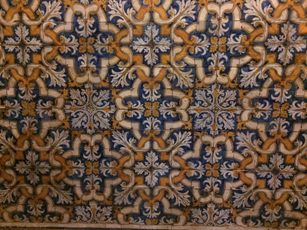
The earliest azulejos in the 13th century were panels of tile-mosaic known as alicatados – derived from the Arabic qata’a (‘to cut’) – introduced by the Moors to the Iberian Peninsula. Tiles were glazed in a single colour, cut into geometric shapes, and assembled to form geometric patterns (so-called Islamic or Mudejár design). Beautiful examples can be admired in the Alhambra of Granada and the Alcázar in Seville, Spain, and to the present day in Morocco.
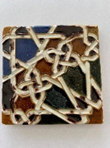
Towards the late 15th and early 16th centuries, Seville became an important centre for the mass production of a type of tyle known as cuenca (‘hollow’) or arista (‘ridge’). In this techniques, motifs were formed by pressing a metal or wooden mould over the unbaked tile, leaving a motif delineated by thin ridges of clay that prevented the different colours from merging into each other during baking.
The same techniques were introduced into Portugal by King Manuel I – after a visit to Seville in 1503 – who subsequently decorated his residence palace in Sintra with azulejos. The Portuguese adopted the Moorish tradition of horror vacui (‘fear of empty spaces’) and covered both the walls and floors with tiles.
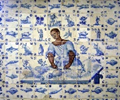
During the Era of Discovery and trade with the East, Europeans became fascinated by the elegance of Chinese porcelain and the Dutch began making tiles in similar blue and white tones in an attempt to imitate this technique.
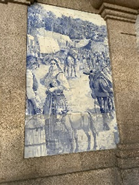
In the second half of the 17th century, these blue-and-white tiles from Delft were introduced into Portugal. Craft shops in the Netherlands created large tile panels with historical scenes for rich Portuguese clients. However, at the end of the century, King Peter II stopped all Dutch imports and homemade blue-and-white figurative tiles became the dominant fashion, superseding the former taste for repeated patterns and abstract decoration.
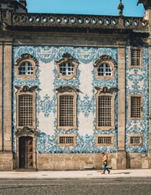
The late 17th and 18th centuries became the ‘Golden Age of the Azulejo’. Mass production not just started because of greater internal demand, but also because of large orders coming from the Portuguese colonies i.e. Brazil. Churches, monasteries, palaces, and even ordinary houses were covered inside and outside with azulejos, many with exuberant Baroque elements. Scenes of daily life, landscapes, and biblical stories graced the ceramic canvasses.
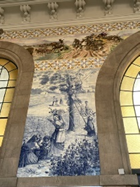
At the start of the 20th century Art Nouveau-azulejos started to appear. Rafael Bordalo Pinheiro founded a ceramics factory – nowadays a museum – in Caldas da Rainha, where he created pottery designs and decorative plates. Art Deco-azulejos made their appearance in the 1930s. The monumental decorations in the São Bento railway station in Porto – consisting of 20,000 azulejos – show historical themes of a romantic lifestyle.

The oldest, still functioning tile factory – called Sant’Anna – is situated in the capital since 1741. Today, 90% of its production is exported abroad.
The Museu Nacional do Azulejo (National Tile Museum) in Lisbon is worth a visit as it houses the largest collection of Portuguese tiles in the world.
Boa semana Enjoy the week