Pão-por-Deus
Portugal’s bread for the poor souls
November 1st – All Saints’ Day – is a national holiday in Portugal dedicated to honouring the saints and the memory of the deceased. Children used to roam their neighbourhoods calling for Pão-por-Deus (Bread for God’s sake). Residents answered with bread, cakes, dried fruits, nuts, and sometimes a few coins. It is one of the country’s oldest customs, blending charity, catholic faith, and remembrance of the dead.
Except for children going from door to door, it is traditionally a day for paying tribute to deceased family and friends, when people take advantage of the public holiday to visit cemeteries, lay flowers on graves and light candles.
The tradition’s roots are tangled. Many scholars connect it to the medieval practise of ‘souling‘ found across Europe, where the poor received food in exchange of praying for the souls of a household’s departed.
Others see older echoes of pre-Christian autumn festivals that marked the turn from harvest to winter, when the boundary between the living and the dead was believed to be thin. The Catholic church folded these customs into All Saints’ and All Souls’ Day (November 2).
Portuguese tradition adds its own legend linking the custom to the catastrophic Lisbon earthquake of November 1, 1755, which struck mid-morning on All Saints’ Day and left survivors begging for food in the neighbouring towns.
At its heart, Pão-por-Deus is about giving. Offering bread, the most basic food, was an act of charity in the name of God. Those who received it were expected to pray for the donor’s deceased ones, so the change was as much spiritual as material.
A soul cake (or soulmass-cake) is a small round cake with sweet spices, especially made for All Saints’ and All Souls’ Day. The cakes, often simply referred to as ‘souls’, are given out to the children who go singing and begging from door to door.
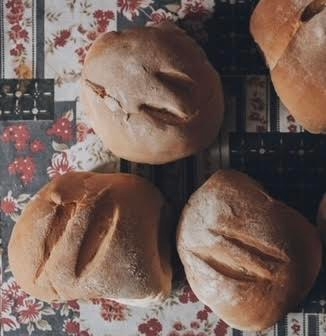
However, you can taste the ‘custom’ all year-round in the pastry shop. There, Pão-de-Deus (God’s bread) is a soft, sweet bun covered in a sugary coconut crust, sharing almost the same name!
Today, the tradition faces competition from Halloween – celebrated on the Eve of All Hallows (holy) Day, also known as All Saints’ Day – whose costumes and candy have captured many children’s imaginations.
Celebrated in Europe for centuries, immigrants brought Halloween customs to North America in the 19th century. Popular Halloween activities include dressing up, carving pumpkins into lanterns, telling frightening stories and visiting haunted attractions.
At the beginning of the 20th century – following the establishment of the Republic in 1910 – the religious day was abolished for decades but reinstated in 1952 by dictator António de Oliveira Salazar in a country where 80% of the population continues adhering to the Catholic faith.
Enjoy the week Aproveite a semana (pic Pexels.com)
