
qahwa -kaffa – kahve –capha- cafeh – caffé – café – koffie – coffy – coffee
The origin of the word coffee is probably derived from Kaffa, the name of an Ethiopian kingdom in the 15th century. At that time in Yemen a beverage was prepared from a plant of Ethiopian origin, which proved to be useful to keep the Sufi mystics awake for praying at night. The word used for the beverage was qahwah, and considering that the plant came from Kaffa, it is not unreasonable to think that there would be a relationship.
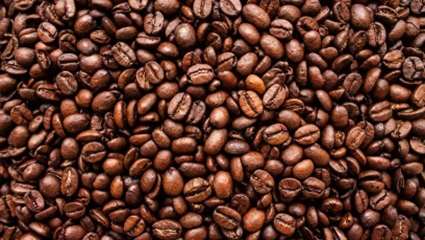
Etymologists, however, are inclined to consider the word being a derivation from a word that meant ‘wine’ in Arabic. A non-alcoholic wine; the perfect solution for Muslims who needed a stimulant but were not allowed to drink alcohol.
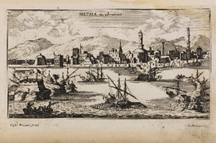
Coffee sales were centred in the Yemeni city of Moca and spread from there throughout the Arabian Peninsula.
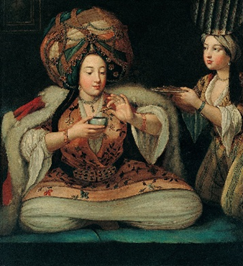
In the 16th century, the governor of Yemen, Ozdemir Pasha, took the coffee to the court of Suleiman the Magnificent, and from then on coffee became popular in Istanbul, and thereafter in the entire Ottoman Empire, under the Turkish Ottoman name kahve.
Cafés were booming in the capital, and the sultan introduced coffee masters in his court. Anyone who wanted to be someone in the Empire had to have at least someone who knew how to prepare good coffee; nowadays called baristas!

From Istanbul, it wasn’t difficult for the beverage to reach Venice, one of the biggest trade centres in the world. There might have been those who thought it a little suspicious for Christians to drink a Muslim beverage but when beverage coming from the depths of Arabia delighted the palate of the Pope, no Christian hesitated to have a coffee, which the Italians called caffè.
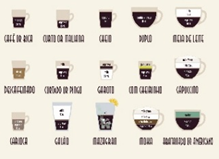
The popularity of coffee thereafter spread across the capitals of Europe, and finally arrived in Paris, where it ended up being one of the central elements of the city’s identity under the French name café, the same name also used for the beverage in Portugal, where the first coffee roasters appeared in Lisbon in the 17th century.
But there was – besides the southern route across land via Istanbul – a second northern route through which the habit of drinking coffee spread throughout the continent, in a similar way as tea was introduced in Europe. And once again, Dutch ships were involved, which transported the product directly from Yemen to the UK.

In 1652, the first English coffeeshop was opened in Oxford and soon after coffee shops expanded as popular meeting points in London. Unlike the word café – which came via the South – the word coffee comes from the Dutch word koffie.
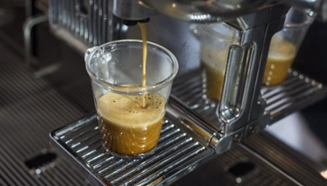
The word espresso comes from the machine that, from the mid-20th century onwards, was used to create espresso coffee. Previously, the beverage was prepared in the Turkish way, mixing the ground beans with boiled water. Now, with the machine, the coffee is prepared with hot water passing under pressure over the ground beans and running through a small spout (called bica) into the cup.
In Portugal, the usual word to ask for an espresso is the word café (or bica).
So, whoever asks for café – just like that – is asking for an espresso.
Enjoy the week Approveite a semana
 There are roughly two ways to say tea in the world. One is like the English expression – thee in Dutch, tee in German or thé in French. The other is a variation of cha – chay in Russian, chai in Swahili or shay in Arabic. Both variations come from China. The words that sound like cha spread across the land, the tea saying spread over water.
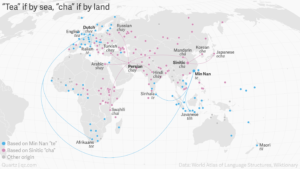 But the Chinese character for cha is pronounced as te in the Min Nan variety of Chinese, spoken in the coastal province of Fujian.
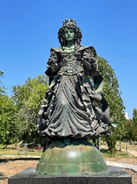
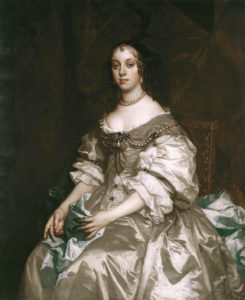 Although it’s fairly commonly known that tea originated in China, it is far less known that it was a particular Portuguese woman, who inspired its popularity in England. Let’s go back to 1662, when