Tag Archive for: international

TO HOLD, TO GIVE, TO RECEIVE is the theme of the Coimbra Biennale ‘26
If you decide to visit the 17th century Monastery of Santa Clara-a-Nova – perched atop a hill in the Portuguese university city, and overlooking the medieval centre of Coimbra from across the Mondego river – do bear in mind that the place might be haunted.
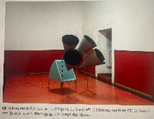
You need nerves to walk through the black ground-floor corridor of the dormitory wing, where tortured wails ambush you from the monkish cells. Sung in Albanian, Chinese , Kurdish, Kyrgyz and Turkish, these laments are part of an installation (‘Start Again the Lament’) by US artist Taryn Simon.
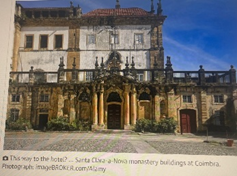
After the last nun died in 1891, Santa Clara-a-Nova served for almost a century as a barracks for the Portuguese army, and since 2015 the convent has been the central hub of Anozero, a biennal art festival with works from all over the world. But that arrangement however, could soon come to and end as the government has recently granted a private company the right to develop the former nunnery into a hotel.

The concept of a city hosting an international art exhibition at regular intervals goes back to the first Venice Biennale of 1895, when the capital of Veneto sought to rejuvenate the Italian art market. The festival brought in visitors who would later return as tourists, while also granting the local population access to international artworks.
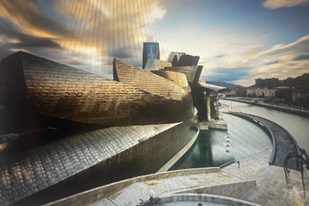
In the 1990s – fuelled by cheap air travel and the Bilbao effect – every city wanted its own biennale such as Kassel’s Documenta, New York’s Whitney Biennal and the Bienal de São Paulo. But with the boom came backlash: the suspicion that biennales were above all an excuse for a select, international art crowd descending on a city for just a few weeks and leaving behind a large carbon footprint but little meaningful engagement with the local population.
Despite being around since 2015 and operating on a modest budget, Coimbra’s Anozero has been at the forefront of art festivals trying to rethink the format.
’In Portugal, we have a tendency to live on old glories,’ says Carlos Antunes, co-founder and director. ‘The biennal is meant to be a door to the future.’
This year, Anozero’s curators propose a new remedy for biennale fatigue: anarchism. Its title Segurar, Dar, Receber ( to hold, to give, to receive) turns out to be inspired by Kropotkin, the Russian anarchist philosopher. Anarchism here does not mean anarchy but cooperation. Kropotkin’s idea was that mutual aid was more central to evolution than Darwin’s idea of the survival of the fittest.

For the opening, Portuguese artist Vasco Araújo led a delegation of 260 singers – all dressed in white and taken from local choirs – on a march from the city’s central square to the convent, while singing a chorus from Verdi’s opera Nabucco.

For its next edition in 2028, Anozero is teaming up with Manifesta, the nomadic cultural biennale, that travels to a different location in Europe every two years.

Anozero runs at the Monastery of Santa Clara-a-Nova and various venues across Coimbra until July 6

Enjoy your week          Aproveite a semana               (pic Público/Guardian)

‘Rail is the only means of transport that reduces CO2 emissions while increasing transport volumes’

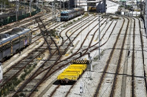
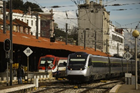
The narrative of Portugal’s high-speed rail connections to Madrid, Porto and the Spanish city of Vigo is back on track in this European Year of Rail with Portugal chairing the Presidency of the EU.

It started some 20 years ago when the former Minister of Infrastructure João Cravino promised to link Lisbon to Porto by train in 1 hour and 15 minutes. The high-speed rail project, however, went up in smoke through lack of funds.

Lisbon is nowadays one of the few capitals in Europe – besides Athens and Talin – without international rail connections. In March last year, both theSud-Expresso (to Hendaye, on the French-Spanish border) and theLusitânia Expresso (to Madrid) were suspended due to lack of profitability and the coronavirus pandemic.

These days a trip by train from Lisbon to Madrid requires 4 trains and 3 transfers. The journey of 600 km takes a little more than 10 hours and costs about 55 euros.

Portugal’s national railway and metro network has 528 stations. The 10 busiest – 8 in Lisbon and 2 in Porto – handle 38% of the 24 million passengers every month. The most overloaded station Cais do Sodré in Lisbon belongs to a metro network that doesn’t even has a connection to the national railway network.

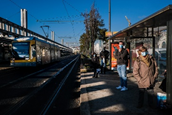
Cais do Sodré is also the end of the suburban railway to Cascais and has a flow of 1.5 million passengers per month, just as much as the two busiest stations in Porto.

This decade the government will – with the help of EU grants – invest over 10 billion euros in 16 rail projects. Half of this amount is earmarked for the high-speed connections Lisbon – Porto (travel time 75 min) and Porto – Vigo (time 60 min). The high-speed rail Lisbon – Madrid (time approx. 150 min) is under construction and due to be finalized December 2023.

The other half of the 10 billion project serves the creation of new metro and train lines, the modernisation of existing lines and the purchase of rolling stock.

During the past decade, the use of cars in the Lisbon metropolitan area has increased significantly, leading to more congestion, pollution and noise. One of the key modernisation projects therefore is to improve the nation’s second-busiest railway Lisbon – Cascais in order to encourage sustainable and environmentally friendly (inter)urban mobility.

The existing 1500 volts DC electrification system on this 25 km course is completely different from the rest of the country’s railway network and the trains used are only suitable for this trajectory. Putting in place new 25 thousand volts AC overhead lines will not only enable integration in the national network but also result in 50% energy savings.

Before the purchase of new carriages, the 17 stations along the line will be upgraded and made more user-friendly. Moreover, its platforms have to be standardized to guarantee that new trains from the national network can smoothly pass and don’t get stuck as happened on a test-drive on Sunday, the 13th of December in São João do Estoril.

Stay safe             Fique saudável                       (pic Público/Sapo)