‘Zé Povinho looks from one side to the other, and stays – as always – the same’
Zé (abbreviation from José) Povinho (‘little people’) is a caricature of the Portuguese everyman, created by Rafael Bordalo Pinheiro – journalist, socialist, publisher of satirical newspapers, and ceramist – in the second half of the 19th century.
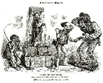
The figure became a symbol of the Portuguese working-class people, critiquing in a humorous way the main social, political and economic problems in the Portuguese society.
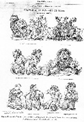
The cartoon made its first appearance in the newspaper A Laterna Mágica (the Magic Lantern) in 1875. Zé Povinho is often depicted with his mouth open and not intervening, resigning when faced with injustice or corruption and unaware of the big issues in the country. He is an expression of the common, simple man.

He became a popular figure of the Portuguese people in the tri-dimensional ceramic form made by the Bordalo Pinheiro factory in Caldas da Rainha – 75 km north of Lisbon – that is celebrating its 150th anniversary this year.

The Bordalo Pinheiro museum in Lisbon opened an exhibition last week commemorating the anniversary of the creation of the character Zé Povinho by visual artist Bordalo Pinheiro (1846-1905).
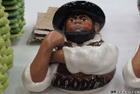
The exhibition (until September 6) is entitled TOMA! – referring to the figure’s characteristic gesture of the arm, representing his revolt and insolence – and presents 400 Zés Povinhos created over one and a half century.

The collection brings together pieces by various artists, from its creator to well-known contemporary artists and anonymous potters in the most surprising materials; from glass to magazine covers and textiles.
The museum director, João Alpuim Bothelho, emphasizes that Bordalo Pinheiro’s humour always has a political touch but is not populist and that Zé Povinho is a ‘universal figure’ due to his essence, giving as an example the many foreign visitors who find a parallel figure in their own home countries.
Enjoy your week Aproveite a semana (pic Lusa/Sapo)
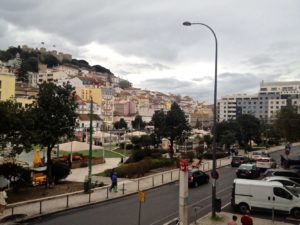 The history of Lisbon and Mouraria – one of the city’s oldest quarters – both originate from the presence of diverse people and cultures. In 1143, Lisbon was conquered from the Moors by King Alfonso Henriques, becoming a Christian city. The birth of Mouraria goes back to the same period, built outside the walls as the only territory where Moors were authorized to reside.
 In the 16th century, the first black migrants were forced into slavery in Lisbon, in that era the largest European centre of the flourishing slave trade. The number of slaves present in the capital reached 10% of the total population, that time comprising 100,000 inhabitants.
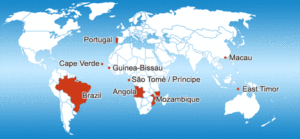 On 25 April 1974, Portugal became a democracy after 48 years of dictatorship. Between April and November 1975, Portugal took in half a million Portuguese and their descendants from its
  Mouraria is the most multicultural neighbourhood of the capital. Here you find everything from African grocers to Chines tea, Indian clothing, religious talismans, Bengali restaurants, mosques and halal butchers. The percentage of foreign residents (25%) is well above the average for the city (10%) and the nation (less 4%).
 In the heart of Mouraria resides the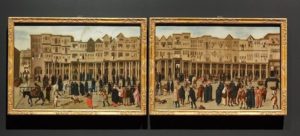
 Since Portugal has been declared World’s Leading Destination and Lisbon Best City Break in 2017, I’ am sure you are dying to visit the country in order to see for yourself, whether these prestigious awards are justified.
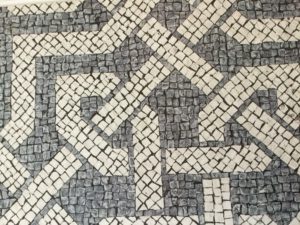
 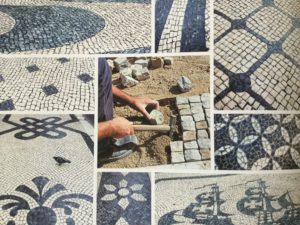 However, that hasn’t always been the case. It started as a forced task performed by prisoners in the nineteenth century. Only later it evolved into a craft and pavers (calceteiros) became recognized artisans, whose art became appreciated in such a way, that it spread to many cities and continents.
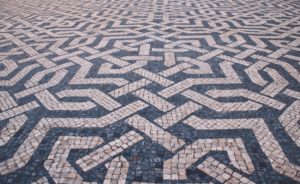
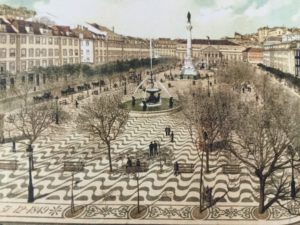 It became an immediate success and similar works were ordered, such as the paving of Lisbon’s major square Praça D. Pedro IV – popularly known as Rossio (meaning ‘wide and public space’) – that took place between 1846 and 1849.
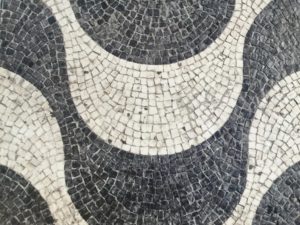 The pavement of Rossio was called ‘Wide Sea’ (Mar Largo) for depicting waves, symbolizing the encounter between the Tagus river and the Atlantic Ocean, which launched the Portuguese into the Discoveries in the 15th century. After Rossio, Lisbon adopted mosaic pavement for all its squares and sidewalks and it became the most popular pavement in historic Portuguese towns and famous worldwide.