‘As you are drawing something, it often turns into something else’ (Paula Rego)
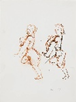
Story Line is the largest ever exhibition of the drawings of the Portuguese-born artist Paula Rego.
Curated by her son, Nick Willing, the exposition features work on paper from the 1950s, right around the time she settled in Britain, to her death in 2022.
Rego was born in 1935, during the early years of the Salazar dictatorship, and criticised the fascist regime in her art until it was overthrown in 1974. By then, she was married to fellow artist Victor Willing, and lived in England. Apparently her father had told her, aged 17, to leave Portugal, where women were repressed, and for the rest of her life she would fight against that.
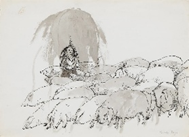
Swineherd (1969) ‘is an example of a drawing inspired by Hans Christiaan Andersen’s fairytale. Paula’s version puts the girl among the swineherd’s pigs, wearing a giant spider for a shawl. In Jungian psychology the spider is a powerful symbol for ‘Shadow’ (the repressed part of the self) and ‘Mother’ as creator. The web can represent entrapment but also creativity.’
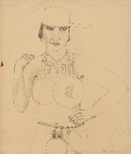
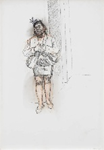
Unknown Title (1973) ‘There is both an air of acceptance of her situation and a hint for rebellion. This woman, who looks conspicuously like Paula, has spent so much time in the kitchen that she is literally dressed in pots, pans and cutlery. Although she appears resigned to wearing lingerie, she is clearly testing the male gaze in an act of defiance.’
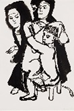
Girl and Dog with Nuns (1986) ‘The dog was undoubtedly chosen instinctively. Dogs embody devotion and loyalty. Paula is not exploring nursing, she is playing with her faithfulness, testing it, prodding it, and most of all, subjugating it.’
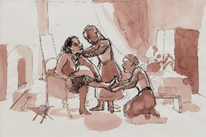
Study for The Maids (1986) ‘ In Genet’s play two housemaids plot to kill their mistress. Its psychologically charged drama triggered a string of personal memories which felt very modern, very universal to Paula. She connected the power struggle and role reversal within an ordinary domestic setting to her own upbringing.’
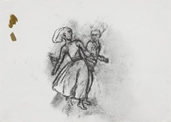
Study for the Dance II (1988) ‘Here she was trying to express movement and, more specifically, a kind of folk dance she had grown up with. This was Vic – her husband – adopting her steps, as he had done thirty years earlier when he moved to Portugal, learned to speak Portuguese fluently and embraced his new life.’
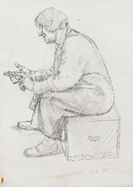
Study for Crivelli’s garden (1990) ‘Perhaps her most famous picture from her residency in the National Gallery. Paula decided to make it a celebration of women, not least because women are poorly presented in the National Gallery, and choose to feature female saints. She invited people who worked in the gallery to pose for her, as well as family and friends, and made lots of studies before embarking on painting.’
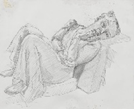
Study for Embarkation (1992) ‘When Paula left the National Gallery, she moved into a temporary studio in Islington. Here she continued exploring memories from her past with Vic, and in particular, experiences that she had not yet properly processed.’
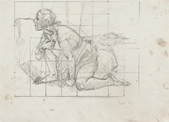
Study for Jenufa (1995) and the subsequent painting tell a nuanced story. ‘The pose was carefully considered. This is not a woman on her knees, but crouching, ready to leap. Her Jenufa is not a victim, but a survivor, with a strong body braced to face whatever the world throws at her.’
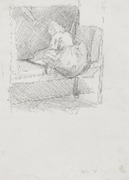
Study for Untitled / Abortion Series (1998) ‘She made a series featuring young girls, some in school uniforms , recovering from illegal abortions. What history taught us – Paula said – is that this always will go on, whether we approve it or not. To protect the lives of our daughters, sisters, mothers and aunts, we need to reach past our religious or political allegiances and grasp a compassionate public health solution.’
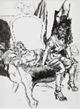
Don’t Leave Me II (2000) ‘What is touching about this drawing is its ambiguity. Who is saying this to whom? Don’t leave me, daughter, or don’t leave me, mother? As ever, by drawing it, Paula was trying to understand how she felt, and what this might mean for her.’
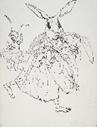
War Rabbits (2003) ‘You can do anything to rabbits, Paula once said. However, these are not real rabbits; they are masks and dolls which also echo human forms, paradoxically flung into the heat of the battle, embodying a callous dialectic of violence, which normalises the slaughter of those we value most.’
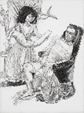
She Doesn’t Want It (2007) ‘Drawing took over her painting in 2007. She made a series of large works with conté and graphite, which were unveiled in New York in 2008. The work She Doesn’t Want It examines the casual brutality of coerced sex work.’
Paula Rego: Story Line is at Victoria Miro in London until 23 May
Enjoy your week Aproveite a semana
(pic © courtesy Estate of Paula Rego and Victoria Miro)


