Tag Archive for: endangered species

Portugal boasts ten official nature reserves
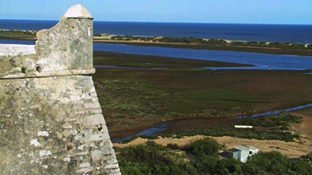
The best places to find flamingos in Portugal is in the Algarve. While flamingos usually do not breed there, they make a stop in the wetlands of Portugal. Throughout the year, they can be seen in the Ria Formosa Natural Park – the impressive wetland spanning over 60 kilometres along the coast between the beaches of Garrão and Manta Rota.

However, the best time to spot them is between November and March. Breeding season takes place between March and July.
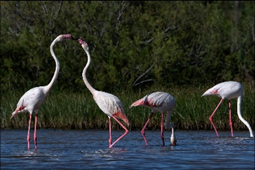
The Greater Flamingo – which is the species usually found in the region – prefers to feed in mudflats and shallow lagoons with salt water. These birds use their long legs and webbed feet to stir up the mud and water, creating a muddy soup that they filter through their uniquely adapted bills, which are specially designed to filter out small shrimp, molluscs, seeds, and algae.
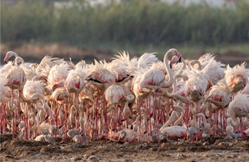
As of 2021, the Algarve saw a group of flamingos successfully establish a colony, resulting in the birth of 550 chicks, making it the first successful nesting in the country. The colony began in one of the saltpans of the Castro Marim and Vila Real de Santo António Natural Reserve, located at the mouth of the Guadiana River, bordering Spain.

Although the event hasn’t repeated, the National Forest and Nature Conservation Institute (ICNF) investigates ways to encourage nesting again. ‘It was an atypical year’, explains João Alves, biologist at ICNF. ‘Nature tourism was restricted because of the Covid-19 pandemic, and the area where they nested became much more quiet. ‘Remember that flamingos nest in colonies’, he added.
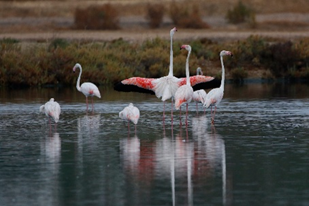
This protected area – spanning over 2,300 hectares – is Portugal’s oldest natural reserve, created 50 years ago. The establishment of the reserve also prompted traditional salt workers to form a cooperative, boosting economic activity in the area. What once was a neglected stretch of salt marches and brackish lagoons is today a thriving habitat, visited by thousands of nature lovers each year.
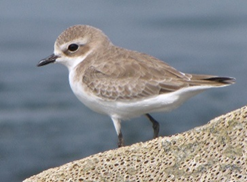
Except a sanctuary for flamingos, the area is home to over 200 bird species, such as Avocets, Black -winged stilts, Audouin’s gulls, spoonbills and Kentish plovers. Meanwhile, across the border in Spain, Doñana National Park – one of Europe’s most iconic wetlands – is suffering under prolonged drought, giving rise to an unexpected influx of Spanish nature tourists visiting Castro Marim.  
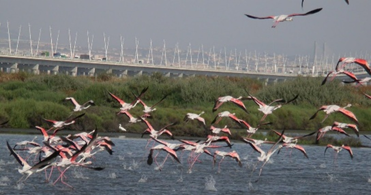
Another significant wetland where pink-feathered flamingos can be admired is the Tagus Estuary, situated near Lisbon, and a vital stopover for migratory birds.

The nearby Sado Estuary, located in the Setubal district, is above all famous for its white storks (and of course dolphins).


Enjoy your week                   Aproveite a semana      (pic Ptres/Público)
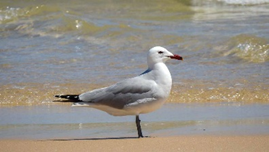
The Algarve houses the largest colony of Audouin’s gulls in the world

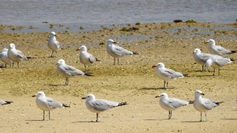
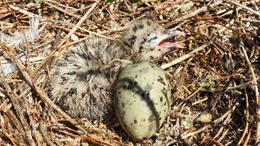
The Audouin’s gull is declining around the world but flourishing in the Algarve, establishing there the largest colony in the world. Year on year this threatened species has increased since settling in the Ria Formosa a decade ago. More than seven thousand nests were counted this year, three times more than in 2019 when the LIFE Ilhas Barreira project started.

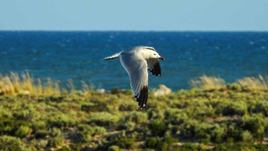
This grey-legged gull is identified by its red bill and -unlike other species of gulls- continues to feed mainly on fish and rarely consumes waste from skips, bins or other types of human waste. Worldwide the species only breeds in a small number of colonies, which leaves it very vulnerable to human disturbance.

In Portugal, the Life Ilhas Barreira project – funded by the EU LIFE programme – has minimized this threat in the species’ main breeding colony, the Deserta/Barreta island. The results are visible. Not only has the breeding population of the Audouin’s gull increased every year, the species has expanded to the neighbouring island Culatra.

‘This new colony in Culatra provides more security for the future’, says Joana Andrade, coordinator of the LIFE project and the marine conservation department of the Portuguese Society for the Study of Birds (SPEA)
‘By safeguarding these areas, we guarantee that the birds have alternative places to nest in case of human disturbances or environmental changes’.

Another endangered bird as a result of habitat destruction is the owl. Only seven out of a possible 250 species worldwide can be found in Portugal. Owls generally breed in winter, making that season a more vocal and active season for them.

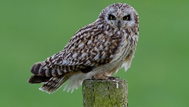
The Short-eared Owl (Coruja-do nabal) is between 34 to 43 cm in length and widely distributed across Portugal.

They mostly hunt in daytime when voles, their favourite meal, are active.

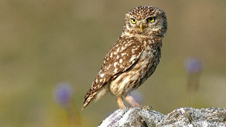
The Little Owl (Mocho galago) only measures 21-23 cm in length.
Except swooping down silently on their prey, they also hop around, pecking in search of insects, small reptiles and frogs.
They have the most extensive range and population of any owl in Portugal.

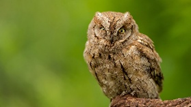
Euroasian Scops Owls (Mocho d’orelhas) are tiny owls – a little smaller than the Little Owls, measuring only 19 cm in length – that feed mainly on insects (crickets and beetles).

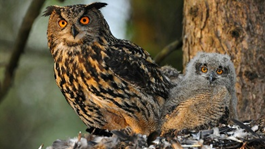
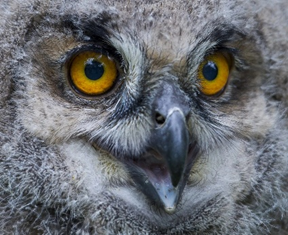
By contrast, the Euroasian Eagle Owl (Oehoe) is a top predator and the biggest in Europe, measuring 66 to 71 cm in length and a massive 2m wingspan. They prey on small mammals and birds and are at their most vocal in the autumn and winter, with the male’s territorial ‘oehoe’ call, deep and resonant.

Barn Owls (Suindara), 34 cm in length, tend to inhibit abandoned barns.
Farmers love them because they keep the property rodent-free.
Their screechy sound is more reminiscent of a hawk. They can carry prey up to 200 grams

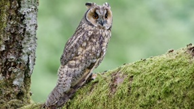
The Long-eared Owls (Bufo pequeno), measuring around 34 to 40 cm, are also known as Cat Owls because of their cat-like facial features.
They are tough to spot. During the day, they usually hide upright against the trunk of a tree.

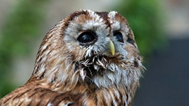
In urban areas – particularly in areas with wooded habitats – you may found Tawny Owls (Coruja-do-mato), circa 38 cm in length.
As nocturnal hunters, they remain silent on perches and locate their prey by hearing.

Owls are predators, developed to capture and kill. Under the feathers the owl has a sharp hooked beak and eight strong arched talons – sharp hooked claws, one per toe, four per leg – excellent ears and most can fly in absolute silence. They are best known for their typical hooting calls.
Young owls (owlets) leave the nest before they’re able to fly and climb into nearby branches using their beaks, claws and wings. Five to six weeks after they hatch they start flying and hunting on their own.


Enjoy the week            Approveite a semana               (pic PtRes/Eaglewatch)