Tag Archive for: nature

‘We cared for her for over 13 years, and she will be hugely missed, but we could not see her living alone any longer’ – Antwerp’s zoo director.
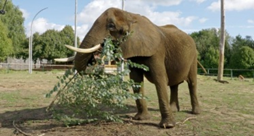
Kariba, a female elephant from the zoo in Antwerp, Belgium will be the first resident to arrive at a new large-scale sanctuary being created on land located in the Alentejo – i.e. in the municipalities of Vila Viçosa and Alandroal.
‘We expect Kariba to arrive early next year,’ revealed Kate Moore, the managing director of the non-profit organization Pangae.
The elephant came from Zimbabwe to Europe, where she lived the last 40 years in various zoos, but will end up living her final years in the sanctuary

Regarding the budget, the director said that – over approximately 10 years – the organization expects to invest 15 million euros.

Pangea was set up to solve a practical problem. Over 600 elephants are living in captivity across Europe. Most EU states have banned the use of elephants in circuses and zoos, yet without sanctuary space, they are hard to implement. Lack of alternatives means that the animals languish alone or in unsuitable conditions for years on end.
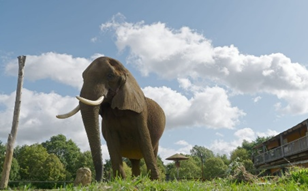
‘Elephants are deeply intelligent, sentient and social. Their needs are complex, and when not met, they suffer,’ emphasizes the director.
‘Our mission is to provide lifelong sanctuary with both specialist care and a space to live with dignity and autonomy in the most natural surroundings possible.’  
Miguel Repas, the organization’s technical consultant, explains that the reserve will provide the animals with ‘tranquillity, peace and freedom,’ and therefore will not be open to the public. However, programs for schools are planned, and a so-called ‘discovery centre’ will be created, offering experiences and interactions with elephants
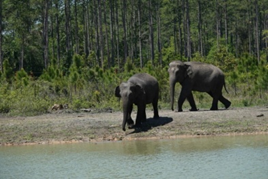
Remembering that the sanctuary’s future guests ‘have never had contact with nature’, the biologist stressed, and that the animals will ‘have to relearn how to live in the wild and socialize’ with other elephants.
The sanctuary will have stables to house the elephants, a central support services area and fences capable to withstand a load of 60 tons.
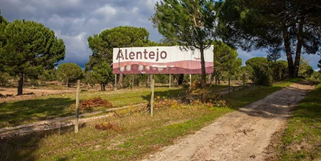
The two mayors from Vila Viçosa and Alandroal welcome the initiative and the opportunities it brings.‘This is a project the Alentejo can be proud of. Pangea benefits not only elephants but our communities too: new jobs, business for local suppliers and visitors to the region.’

With an estate of 1,000 acres, this will be the first large-scale reserve in Europe for elephants that lived in captivity, with a capacity for up to 30 animals.


Boas Festas                                 Happy Holiday     (pic Luso/Sapo)
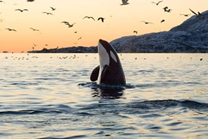


Orcas sinking boats: annoyed or just playing?

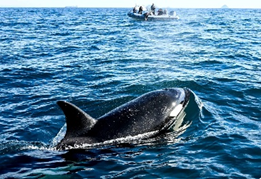
Orcas are known for two things: being very intelligent and being very ruthless.
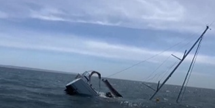
Last month, new incidents with orcas led to the sinking of a sailing boat just off Costa de Caparica (Lisbon) and damaging boats in Cascais Bay. It is the third boat sinking after confrontations with orcas

The first boat to sink in Portuguese waters was a sailing boat of a French family off the coast near Sines in 2022. Later that same year, another boat involving orcas sank off the coast of Viana do Castelo (Northern Portugal).

Violent interactions with killer whales on the Portuguese coast started around the time of Covid. In September 2021, a sailing boat off the coast of Faro and two more boats between Lagos and Sagres (Algarve) were heavily damaged. And only very recently, five crewmembers had to be rescued from the sea after their vessel lost its rudder following an orca attack off Peniche (Leiria district).

It looks like encounters between sailboats and orcas are becoming increasingly frequent. Since the beginning of this year, about 60 interactions have been recorded, six of them in the last two weeks of September.

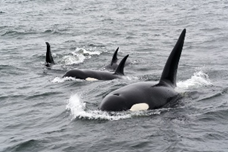
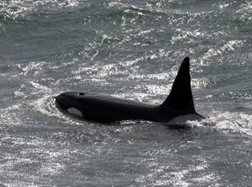
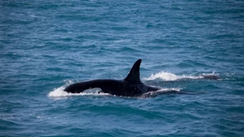
This particular group of Iberian orcas is labelled ‘the killer whales of the Strait of Gibraltar’, although they regularly travel along the Atlantic coast, up to the Bay of Biscay (France), and back again. It is a group largely made up of juveniles hitting the hull and the rudder, which usually continues for around twenty minutes.

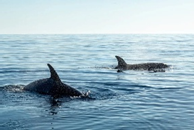
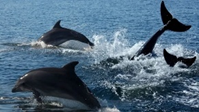
Although known as killer whales, orcas are not whales. The species Orcinus orca is part of the dolphin family and can measure up to eight metres. This behaviour of ramming vessels probably started with individual orcas, but seems to have spread through social learning.

The Orcinus orca subpopulation – not reaching half a hundred animals – was in 2019 classified as Critically Endangered on the ICNF  (International Union for Conservation of Nature) Red List of threatened species.

The reason for the ‘disruptive behaviour’ of the orcas is unclear. According to ICNF biologist Élio Vicente orcas see the ‘rudders as toys. It’s a mobile, it makes noise, and it attracks curiosity. It is not a negative behaviour from their point of view.’ Researcher Rui Rosa emphasises that the people on board never seem to be targeted. ‘The risk around orcas is more of a navigation concern than a direct danger to human life.’

The recurrence of these episodes is already generating economic impact. Fernando Sá, owner of a nautical school in the Lisbon area – explains that he has stopped authorizing tours to the Tagus river mouth for fear of new incidents.
‘The orcas might look at it as a joke, for the people on board it is not.’   


Enjoy the week                     Aproveite a semana      (pic Lusa/Público)