
Portugal plummets in 2025 Corruption Perception Index, with the worst score ever.
The watchdog Transparency International Portugal (TIP) is challenging declarations by the Ministry of Justice on the assessment of anti-corruption policies in Portugal, and rejects claims that the Anti-Corruption Agenda– one of the government’s flagships – contains a clear anti-corruption strategy.
Instead, the Ministry’s technical report 2020-2024 ‘doesn’t provide any evidence of a structured, methodologically identifiable assessment of the results of an anti-corruption strategy in the past four years.’ TIP states.
Even worse, no proposal, timetable, or implementation process is known for the period 2025-2028. ‘The absence of this new strategy raises doubts about the commitments made and the consistency between political discourse and government action,’ the corruption watchdog declares.
Meanwhile, the Ministry of Justice recently announced that it has finalized 17 of the 42 measures outlined in its National Anti-Corruption Agenda. Judge Rita Alarcão stated in the same press release that progress this far demonstrates that it is possible to act with effectiveness.

The Corruption Perception Index (CPI) is an annual indicator compiled by Transparency International that assesses the perception of corruption in the public sector on a scale from 0 (corrupt) to 100 (clean) in more than 180 countries.
Government corruption is increasing worldwide due to a lack of leadership.
This year, the global average GPI score fell for the first time in over a decade, to just 46 out of 100. The NGO’s report reveals that ‘the vast majority of countries are failing to keep corruption under control’, highlighting that two-thirds of countries score below 50 on the index.
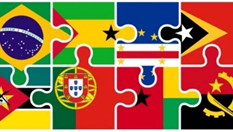
Portugal fell to 46th place, scoring just 56 points out of 100. Cape Verde ranked as the highest-placed nation with 62 points within the Community of Portuguese-Speaking Countries, leaving Brazil (35), Angola(32), and Mozambique (21) far behind.

At the same time, countries scoring above 80 fell from 12 a decade ago to just 5 (i.e. Scandinavia, Singapore), highlighting ‘a worrying trend of democracies showing a deterioration in perceptions of corruption.’
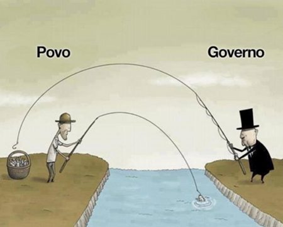
Analyzing the results, TIP president José Fontão points to a correlation between rising perceptions of (state) corruption and the growth of populist rhetoric attacking institutions. He called the politicians to end isolated short-term measures, and above all to show more political will to tackle abuses of power and the factors driving this decline, such as the roll-back of democratic checks and balances, and attacks on independent civil society.

It should not be forgotten that the common people are paying the price, as corruption leads to under-funded public hospitals and schools, unbuilt defences against the climate crisis, and withers the hopes and dreams of young people.
Enjoy the week Aproveite a semana (pic Publico/Sapo)